
5 Artisan Tips to Make Perfume Last in Hot Climates
Citrus, aquatic, green, and light-floral families hold up best when temperatures climb. The single most effective habit isn’t a different bottle. It’s restraint: smaller doses, applied more often, on hydrated skin. Save the heavy gourmands and dense orientals for cooler months, when their weight has room to unfold.
TL;DR:
- Fragrances with citrus, aquatic, green, and light-floral notes perform best in hot weather due to their transparency and lightness.
- Applying smaller amounts more frequently on hydrated skin extends scent longevity and prevents overpowering in high temperatures.
- Store perfumes in a cool, dark place and avoid exposing bottles to sunlight or heat to prevent degradation of aroma compounds.
- Heat accelerates evaporation, causing top notes to fade faster and base notes to appear prematurely, impacting scent balance and projection.
- Lighter concentrations like eau de toilette and travel-sized bottles are ideal for hot climates, offering flexibility and fresher wear throughout summer days.
Table of Contents
- What Fragrance Families Work Best for Hot Weather?
- How Does Heat Change the Way Perfume Behaves on Skin?
- How to Apply Perfume So It Lasts in Hot Weather
- Which Perfume Fits Which Summer Occasion?
- Maison Voyageur’s View on Warm-Weather Perfumery
- How Should You Store Perfume When It’s Hot Outside?
- A Simple Ritual for Hot-Weather Days
- Explore Fresh, Natural Fragrances for Warm Weather
- Sources
What Fragrance Families Work Best for Hot Weather?
Heat rewards transparency. It punishes density. That’s the whole logic behind why certain families feel effortless in July and others feel like a mistake by noon.
Citrus and hesperidic notes lead the list for good reason. Bergamot, lemon, and grapefruit deliver immediate brightness, and they don’t compete with sweat the way heavier notes do. There’s also a psychological piece worth naming: citrus reads as cooling to the brain even when it isn’t lowering your actual skin temperature. The scent becomes a small act of relief.
Aquatic and ozonic accords come next. Sea salt, watery accords, and marine notes diffuse lightly and feel modern rather than heavy, which is why they show up so often in warm-weather formulas built for movement and light.
Green and herbal notes offer something citrus can’t sustain alone: depth without sweetness. Fig leaf, green tea, basil, mint. Perfumers have leaned into these in recent seasons because green accords hold their shape longer than raw citrus top notes, giving a fragrance more staying power without adding heaviness.
Light florals and white flowers round things out. Neroli, orange blossom, freesia. They read as luminous, never cloying, when the formula stays transparent.
Underneath all of these, transparent musks and light woods act as quiet fixatives, anchoring a scent without pulling it toward gourmand territory.
When shopping, a few phrases on a product description tell you what you’re getting before you even smell it:
- “Eau fraîche” or “eau légère” signals a lighter concentration built for heat.
- “Ozonic” or “marine accord” points to aquatic freshness.
- “Neroli heart” suggests a luminous floral center, not a sweet one.
- “Green tea accord” hints at herbal freshness with some staying power.
How Does Heat Change the Way Perfume Behaves on Skin?
Warm skin speeds everything up. Higher surface temperature accelerates evaporation, which means top notes vanish faster and projection increases in the first hour, only to fade sooner than it would in cooler weather.
Humidity complicates the picture further. It can dampen projection at a distance while intensifying that close, warm “skin scent” effect, the kind only someone hugging you would notice. The practical result: volatile top notes disappear fast, and base notes that were meant to arrive gradually can show up early and smell disproportionately heavy.
The science behind that “cooling” sensation is real, even when temperature doesn’t actually drop. Certain molecules, similar to menthol, activate TRPM8 cold-sensing receptors in the skin, producing a perceived cooling effect that has nothing to do with thermometers and everything to do with how the brain interprets the signal.
The practical implication follows directly from the mechanics. Favor airy volatiles, or formulas built with transparent fixatives that slow the base notes down instead of letting them rush the stage. A fragrance engineered for cool weather, worn in heat, essentially skips ahead in its own story before you’re ready for the ending.
How to Apply Perfume So It Lasts in Hot Weather
Longevity in heat isn’t about spraying more. Experts consistently recommend smaller amounts, applied more frequently, because skin in high temperatures both absorbs and releases fragrance faster than it does in winter.
A few adjustments make a real difference:
- Apply lighter amounts across pulse points rather than one heavy spray to the neck.
- Choose the inner arm, chest, and behind the knees for more controlled, closer projection.
- Hydrate skin with an unscented lotion before spraying. Dry skin burns through fragrance faster.
- Carry a travel atomizer or a light body mist for a midday refresh instead of relying on a single morning application.
- Keep sprayed clothing out of direct sun. Perfume that oxidizes under UV light can shift into something unrecognizable.
Pro Tip: Pair your fragrance with an unscented or matching-scent body lotion from the same family. It extends wear time without adding the weight a second spray would.
Which Perfume Fits Which Summer Occasion?
Season alone doesn’t tell you enough. Where you’re going and what you’re doing matters just as much as the temperature outside.
- Office or daytime errands call for something discreet: a citrus or green eau de toilette that reads as clean, never as a statement.
- Beach days and outdoor activity favor aquatic or ozonic mists, easy to refresh from a small bottle without disrupting a light routine.
- Summer evenings outdoors can carry a touch more richness, but stay with transparent musky woods rather than dense orientals. Heavy, overly sweet gourmands tend to feel suffocating once heat and humidity intensify them.
- Travel rewards a small rotation over a single bottle. Pack travel-size eau de toilettes and a couple of sample vials, so the scent can shift with the activity rather than fighting it all day.
Maison Voyageur’s View on Warm-Weather Perfumery
We compose slowly, in the Mediterranean tradition, with 98% natural ingredients. That number isn’t decoration. It shapes how a fragrance behaves on skin in heat, because botanical volatiles and airy natural carriers tend to move more honestly through warm air than dense synthetic bases do.
A fragrance built for introspection doesn’t need to shout to be felt. In heat, that quietness becomes an advantage: transparency reads as presence, not absence.
For hot climates specifically, we lean toward eau de toilette concentrations and travel formats. Smaller bottles, lighter doses, the freedom to carry a scent with you rather than commit to a single heavy application at dawn.
How Should You Store Perfume When It’s Hot Outside?
Heat is the enemy of a perfume’s long-term integrity, not just its performance on skin. Bottles left on a sunny windowsill, in a car glovebox, or beside a steamy bathroom mirror degrade far faster than bottles kept somewhere cool and dark.
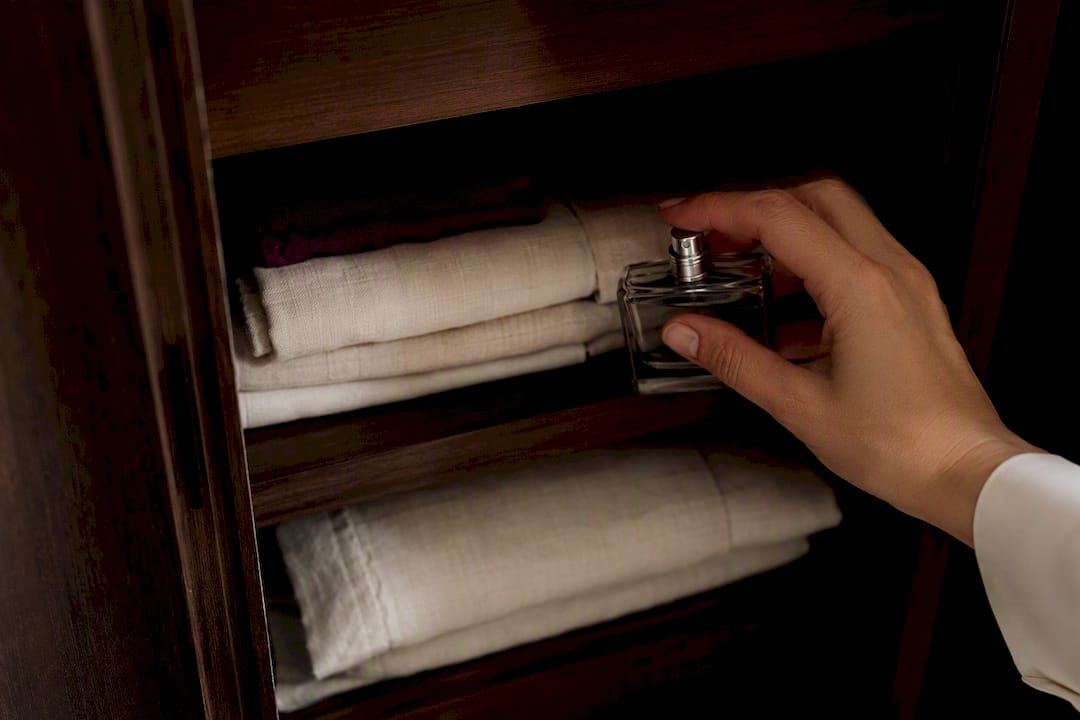
Light and heat both break down the aromatic compounds that give a fragrance its character, particularly the top and heart notes that give citrus and green accords their brightness. A bottle degraded this way often smells flatter or slightly sour compared to a fresh one, even if it looks untouched.
A few habits protect your collection through the warmer months:
- Store bottles in a closed drawer or box, away from direct sunlight, rather than displayed on an open shelf near a window.
- Keep perfume out of the bathroom if it gets steamy. Temperature swings and humidity both accelerate breakdown.
- Travel sizes are useful here too. They limit how much fragrance is exposed to heat in transit, and you’re not risking a full bottle to a hot car or checked luggage.
- If you notice a scent has changed character, gone flatter, sharper, or slightly off, that’s usually oxidation, not your imagination.
The original bottle, kept closed and shaded, is almost always the best storage vessel. There’s no need for anything more elaborate than a cool, dark space.
A Simple Ritual for Hot-Weather Days
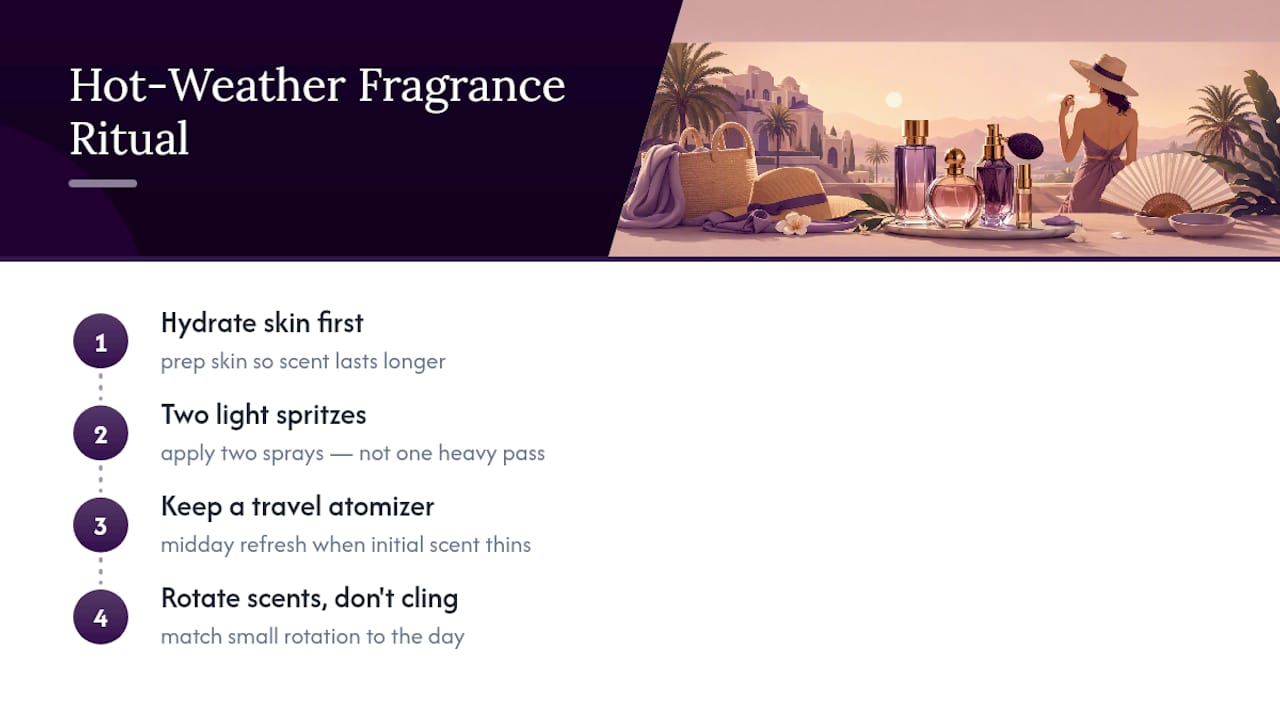
My own routine is unglamorous but reliable. Hydrate the skin first. Two light spritzes, never one heavy pass. A travel atomizer in the bag for a midday refresh when the first application has thinned out.
The bigger shift, honestly, has been letting go of the idea of one signature scent. A small rotation, matched to the day ahead, tends to serve heat far better than loyalty to a single bottle ever did.
— Celeste
Explore Fresh, Natural Fragrances for Warm Weather
If the families described above sound like what your summer routine is missing, Maison Voyageur builds toward exactly that: lighter concentrations, travel formats, and compositions made with 98% natural ingredients that favor airy botanical volatiles over synthetic weight. Nothing mass-produced, nothing rushed. Each scent is composed slowly, in small batches, with warm-weather wear built into the formula rather than added as an afterthought.

Rather than guessing at concentration or committing to a full bottle blind, you can start with a sample or a curated set built around freshness. Visit Maison Voyageur’s Mediterranean perfumerie to browse travel-size options and lighter compositions suited to hot climates, and find the one that fits how you actually want to spend your summer days.